COLOR WHEEL THEORY
- Bansi Dineshbhai Vaghani

- Nov 15, 2021
- 2 min read
15 November , 2021
I found Color wheel very interesting after Rachel’s color workshop and I would like to know more about color wheel that’s why I search on Google about color wheel and I pound some charts and definition which gave me perfect idea about color theory. Color wheels allow color relationships to be represented geometrically, and show the relationship between primary colors, secondary colors and tertiary colors. It is made up of twelve colors, including three primary , three secondary and six tertiary colors.
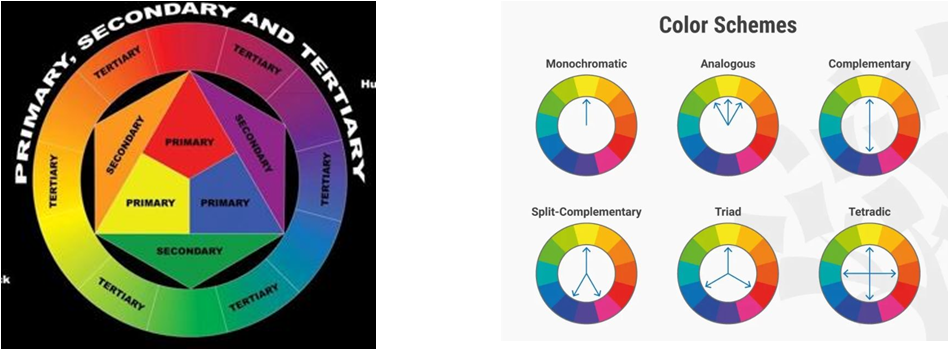
Use a Color Scheme and Color Temperature for Design Harmony
Monochromatic – Take one hue and create other elements from different shades and tints of it.
Analogous – Use three colors located beside one another on the color wheel (e.g., orange, yellow-orange and yellow to show sunlight). A variant is to mix white with these to form a “high-key” analogous color scheme (e.g., flames).
Complementary – Use “opposite color” pairs—e.g., blue/yellow—to maximize contrast.
Split-Complementary (or Compound Harmony) – Add colors from either side of your complementary color pair to soften contrast.
Triadic – Take three colors which are equally distant on the color wheel (i.e., 120° apart: e.g., red/blue/yellow). These colors may not be vibrant, but the scheme can be as it maintains harmony and high contrast. It’s easier to make visually appealing designs with this than with a complementary scheme.
Tetrad – Take four colors that are two sets of complementary pairs (e.g., orange/yellow/blue/violet) and choose one dominant color. This allows rich, interesting designs. However, watch the balance between warm and cool colors.
Square – A variant of tetrad; you find four colors evenly spaced on the color wheel (i.e., 90° apart). Unlike tetrad, square schemes can work well if you use all four colors evenly.
This study of color wheel theory is really helpful and also learn different color schemes which I can use in my designs in different ways.


How are you going to continue to develop your relationship to colour? Keep developing or working with colour exercises? so that you develop a vocabulary personal to you?